

The Yellow Ochre Newsletter
Turn your art from a hobby into a purposeful blessing for your community and culture.
If All the Bibles Went Away…
If all the Bible’s went away, who in your life would you follow around to remember what Jesus was like?
Spend your life attached to someone like that and being someone like that.
Something Kept Pulling Him Back
I love the way Eugene Peterson translated Mark 6:20. Reminds me of the metaphorically nature of following Christ. We’re drawn to the beauty of Christlikeness.
“Whenever [Herod] listened to [John]
he was miserable with guilt—
and yet he couldn’t stay away.
Something in John kept pulling him back.”
Mark 6:20b (The Message)
If I Designed A Training Center for Artists
If I were designing a mission training center for artists, here’s what I’d focus on:
Vision: We’d anchor a worldview for artistic missional engagement.
Gifts Discovery: We’d examine your personal gifts, talents, skills, purpose, angst, and dreams.
Church Planting: We’d connect all niche mission ideas into the larger context of expanding and establishing God’s kingdom.
Equipping: We’d train how to build relationships through serving and building trust with others.
Love is Custom-Made
We create custom made guitars, vehicles, houses, cities, and sculptures.
All the things which fashion our lives contain the world’s raw materials which are then customized to our benefit and liking. When something is custom made, we find it more valuable. We attribute greater care and finesse to something custom made.
Ought agape love not be the same?
Which Micro-Community Do You Serve?
Every community contains 3 spheres: The tribes, elites, and masses.
The Tribe: a specific, micro-community through shared, relational, and embodied culture.
The Elite: the taste-makers, academic spaces, or high-budget patron systems.
The Masses: the wider public market through accessible, widely distributed media.
These three community categories share different values and desire different things. To live your life serving one means to not put forth as much energy into the others.
Having clarity who you’re serving can stabilize you from aiming at the wrong thing.
How to Flatten the Gospel
“If the local congregation is not perceived in its own neighborhood as the place from which good news overflows in good action, the programs for social and political action launched by the national agencies are apt to lose their integral relation to the good news and come to be seen as part of a moral crusade rather than part of the gospel.”
Lesslie Newbigin, The Gospel in a Pluralist Society.
Here is my understanding of what Newbigin is saying: If good actions/works are not the perception of a local church, then the programs come across as moral policing to the church’s neighbors.
This point comes in Newbigin’s chapter “The Congregation as Hermeneutic of the Gospel.” In this particular section, he’s arguing that one of the characteristics for a church community to be such an agent for the gospel, it must localize the concerns of its own neighborhood.
When the church fails to do so, it becomes perceived as a moral agency rather than good news embodied. The greater we generalize or nationalize the world’s needs, the more flattened the gospel becomes for anyone.
How Do You Make Context?
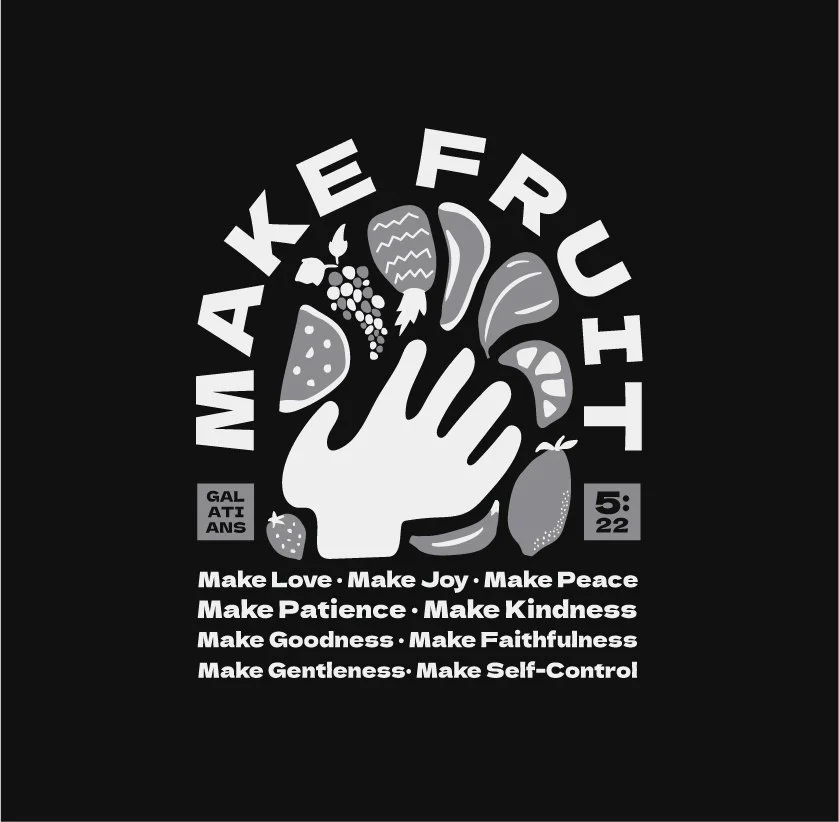
Making disciples is all about making the context for discipleship.
So, how do you do that?
Make Fruit © Matt
You make fruit.
The fruit of the Spirit becomes the context for teaching others. In this way, others do not taste “symbol hypocrisy.” That is the hypocrisy experienced when one’s life does not match their teaching.
Or maybe that’s just called hypocrisy.
Making Life Better
“In the first 30 seconds of meeting them
I knew that they were people I wanted to work with.
And it seemed like being around
them will make life better.”
Rick Rubin on first meeting the Avett Brothers