
The Yellow Ochre Newsletter
A weekly curation of encouragement and practical wisdom to turn your art from a hobby into a purposeful blessing for your community and culture.
5 Lessons About Plateauing Faith from Art-Making
Our imaginations preach at us from years of going to church. Ideas pop into our heads, don’t they? Snippets of truth and untruth. Clippings of truth needing untwisting.
Sometimes, when I feel like my faith in God is plateauing, my trained imagination tells me things like, “read the Bible more!” “Pray more, Matt.” “Evangelize more.”
It is hard to compete with these sayings. They are good things after all, aren’t they? However, God’s wisdom is meant to take scriptural truth and guide us wisely through the specific day-to-day circumstances.
Here are a few things art-making has taught me about those seasons when I felt my faith plateauing:
1. We were designed to make. To be an artist implies you use that skill. Using your craft gives artists the right to call themselves, “artists.” So it is with Christians. Being a disciple of Christ implies your whole life permeates with the life and love of Jesus. We were designed to use what God gave us and steward it. Every time I make something, something that did not exist now exists in the world to be useful and beautiful for whomever. When I say “designed to make” I mean God gave us gifts to invest into the world for his kingdom. Whatever He’s given us, make something with it. When Jesus was asked about the end of world, check out his commands and parable implications from Matthew 24-25. As the disciples and Jesus interact about the destruction about the temple, he says things like this:
Watch out that no one deceives you about signs of Jesus’ return (24:4)
See that you are not alarmed…the end is not yet (24:6)
The one who endures to the end will be delivered (24:13)
If anyone tells you ‘Look, here is the Messiah’… do not believe it (24:23)
Take note of what Jesus is saying here [his coming will be very apparent] (24:25)
Learn the parable of the fig tree: seeing these things means the end is near (24:32-34)
Be alert (24:42), Know this (24:43), Be ready (24:44)
Faithful is the one… (24:45)
…the master who finds the slave working… (24:46)
The virgins who were ready for the bridegroom’s return went in with him to the wedding banquet. Those not ready were not welcome (25:10)
Therefore, be alert, because you don’t know either the day or the hour of the master’s return (25:13)
Invest God’s gifts: The faithful are those who invest their talents God gave them (25:14-30)
Invest in: the needy, hungry, thirsty, stranger, sick, naked, prisoners (25:35-36)
2. Give away. Besides learning to be content and enjoy the gift of artistry from my Father, I’ve learned how fulfilling it is to give that gift away to others. God gave us gifts, skills, and talents to serve and give away. This is not merely giving away artwork (which I enjoy doing) but giving away how to do artwork. There are always people out there who need things (time, talent, skills, mental bandwidth, material goods and services, etc.) you particularly possess.
3. Arts as metaphor for making good works. Arts engage in the realm of metaphor. God gave us each good works to walk in since before the foundation of the world. Good works come about through the act of making them (I’ve written some on this topic here). We make moments with others through words and actions. Have you ever felt encouraged by someone’s words? Ever felt strengthened or motivated by a sports coach to get moving with a renewed kindling toward action? Has a movie ever stirred your heart from a thing? Have you ever been gifted something so wonderful it brought you tears? Yes, those were all things made by someone else. Making isn’t simply about arts and crafts. Making is how we live our lives.
4. Making gives clarity to a thing. Making is all about a journey towards discovery. This might be one of the most misunderstood things about art today. When people view or hear a profane thing, it is easy to conclude the artist has arrived at such destination. Perhaps they have…for that day. But I assure you, art is all about discovery. Picasso’s bulls illustrate this well.
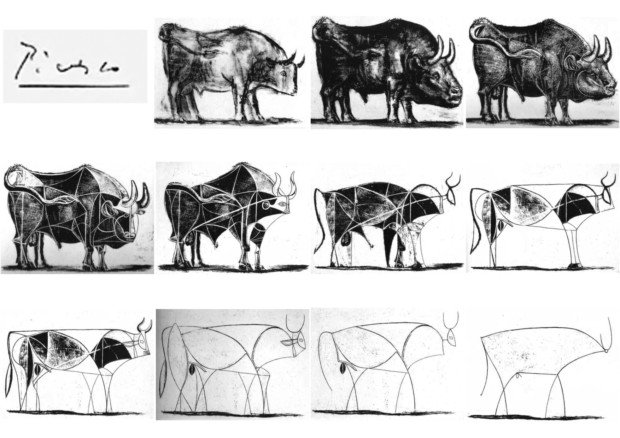
Picasso famously showed this journey of abstraction in his lithographs of the bulls above. Say what you will about Picasso’s own worldview, values, and how he expressed all that. Art making helps us clarify something into it’s simplest form, much like understanding the irreducible minimum of Pablo’s visual bull. Art is the process of getting to see the forest rather than the trees. Understanding this has guided me to focus on the irreducible minimum in bible reading, or, what is God’s heart in whatever passage I read.
5. Making is the completion of understanding a concept. Consuming data is different than learning it. I have found Scripture more crystalizing by engaging in some of the following ways following reading:
Create infographs
Doodle what I’m reading
Napkin drawing of how I’d give that thought away visually
Attempting to write a poem
Writing a song
Painting
These activites have helped my meditation process. And the fruit compounds. I can give these things away. Creating a corpus of Scripturally focused stuff roots the text deeper into my bones.
If we feel our faith is plateauing, what if that restless feeling is because we’ve buried goods things God has given us? What would it look like to use your unique accessible tools which have been on the shelf collecting dust? What will you make with your life today?
No One Person…
So, I possess an unusual amount of pencils.


These don’t even including the common #2 pencils we have around the house. It’s not that I’m a lover of pencils, though. They all serve different purposes. Usually, I underline and write notes in books with a pencil. Other times, I’ve done drawings with them.

Papa Gani (2014). Graphite (pencil). Matt Taylor
But this blurb isn’t merely about pencils. It’s about community and what individuals within that community choose to do.
Did you know no one person can make a pencil.
Actually, it takes an entire global workforce to make one.
Consider this. This global unity project, known as the pencil, is an effort to create one simple, graphite, tool for our lives.
With the invention of the pencil, we can create worlds, jot down tasks, scribble notes, or make a piece of art. When the gift of the pencil is used, it multiplies into many streams of gifts to continually impact the world.
If you are part of the pencil-making process, thanks.
If you are the pencil, use it to bless others.
Two Kinds of People in the End
“There are only two kinds of people in the end: those who say to God, “Thy will be done,” and those whom God says, in the end, “Thy will be done.” All that are in Hell, choose it. Without self-choice there could be no Hell. No soul that seriously and constantly desires joy will ever miss it. Those who seek find. To those who knock it is opened.”
C.S. Lewis, The Great Divorce, 75
Cali Surf With My Brother

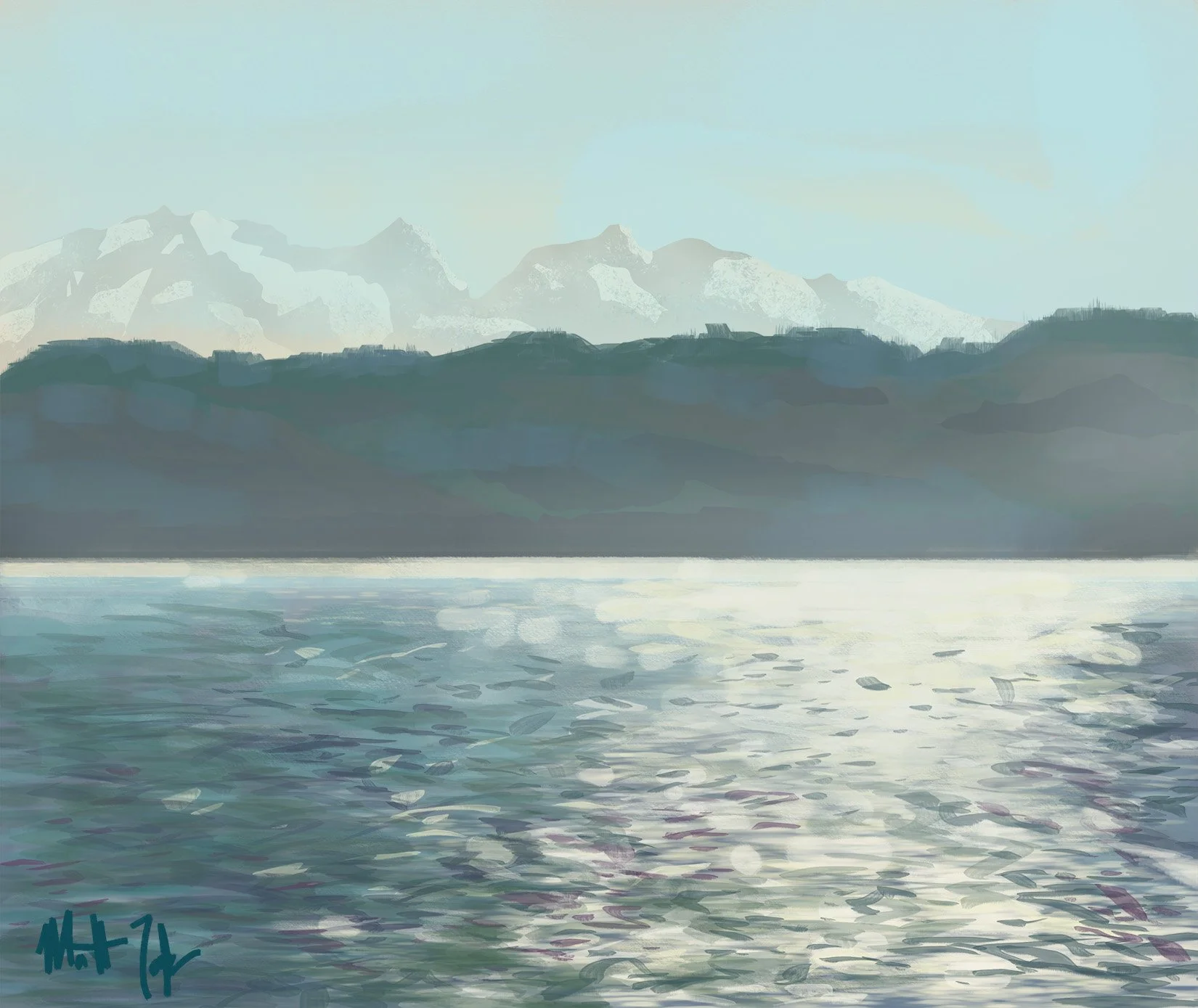
Cali Surf with My Brother (Digital painting, 2022)
It is always a wonderful thing to encapsulate memories into art.
A couple years ago, I visited my brother who lives in California—a place I’ve always desired to explore. Knowing this, my wife gifted me with that opportunity for Christmas. My time with my brother was wonderful. He was a great host who showed me all his favorite spots around the city.
Surfing happens to be one of his newfound hobbies. I was eager to learn from him.
This painting reminds me of that visit. It reminds me of the joy of learning something new (like surfing) and relearning something unclear (like playing with colors in a painting). It reminds me of the beauties of God’s world, of glories difficult to describe with words.
My 16 Favorite Online Painters
A few years ago, I began following more artists on social media. I quickly observed that an unconscious decision to do so resulted in inspiration for creating more art just for the joy of it. It ignited a strong yearning to continue learning and to follow curiosity in the making of art.
After several years, here are sixteen of the most enjoyable and helpful painters I’ve gleaned from. Learning from each of these artists has been like a second art degree program! To be clear, these reflect artists I’ve found personally helpful in my ongoing development in visual arts. They do not represent all artists I look up to or enjoy. They are not all who freely give away tutorials. They are simply ones I’ve come across and go back to. I’m thankful each of them chose to show and tell their work.
If you have any interest in visual arts, check out all of the videos you can by each of these terrific people. These are rabbit trails you want to go down!
Lixin yin
Something clicked in color theory by watching and listening to Lixin Yin. His loosened use of texture, color, and shapes freed me from some of my “stuck-ness” in painting. YouTube. Twitter. Instagram.
Aaron Blaise
Aaron Blaise (The Lion King, Brother Bear) is one of the G.O.A.T. in the animation world. I would say Blaise is responsible for reigniting my love for painting. I also feel like I am watching a 90s Disney movie every time I listen to him. He’s the kind of guy I would love to spend a day with painting, grilling, and asking about his life. Youtube. Instagram. Twitter.
Nathan Fowkes
I should stop saying “G.O.A.T.” because there’s too many on this list. Yet, Nathan Fowkes (The Prince of Egypt, Spirit, Shrek Universe, How to Train Your Dragon, The Legend of Puss in Boots) is one of them! Fowkes unlocked for me even more unconventional rules of color theory. I don’t think I retweet anyone more than I do of Fowkes. YouTube. Instagram. Twitter.
James Gurney
If you have any interest in gouache, illustrator James Gurney is your guy! You’ll find a plethora of Gurney’s material all around the internet. His do-it-yourself mentality helped me break out of my own do-it-by-the-rules mode of art-making. Want to make your own easel? Go for it! Gurney helped me also understand that limitations are a good thing in art. Small sketchbook? Details with small brushes? Limited color palette? Limitations are a path to artistic freedom. YouTube. Instgram. Twitter.
Craig Mullins
Craig Mullins is the guy the G.O.A.T.s look up to. I had forgotten about Mullins. About 20-25 years ago, I saw his digital paintings. I was hooked. It might be one of the top contributions which led me to take art as a serious major in art school. Ask any digital artist, they might say the same. I only wish he had more tutorials online! YouTube. Instagram. Twitter.
Devin Korwin
I came across Devin Korwin via a helpful Twitter thread with some excellent art tips. His use of brushwork inspired me to return to the simplicity of default photoshop brushes. Instagram. Twitter.
Joseph Zbukvic
Watercolor master Joseph Zbukvic leaves me speechless. Watching him is like watching art history in action. Even if you don’t paint, gather the family around your streaming device, grab some popcorn, and watch him work! Instagram. Just YouTube his name!
Stan Miller
Last, but certainly not least, is Stan Miller. Miller’s work is the kind of work I often pull out my phone, show my wife, and with my jaw slightly dropped say, “Isn’t this amazing?!” Miller, a master watercolor artist, has done the the visual artist world a service with some terrific tutorials. Miller, more than more, showed me how you can use really any color so long as the value is correct. YouTube. Instagram.
Works Make Faith Alive!
Recently, I preached on James 2:14-26.
The passage contains one of the Reformation’s most famous texts: Faith without works is dead. Martin Luther depended strongly on this verse as a response to Rome’s salvation-comes-by-works theology. His heart was to say faith alone is all God requires for salvation.
500 years later, the same idea remains: we do not achieve salvation by our works. Jesus’ work on the cross accomplished what we could not on our own. So what is the place for our works?
As I prepared my message, I resonated in a fresh way with this text. I reflected on it as an artist, as a worker. I know James’ concept of works was not exactly art-making. And yet, I wondered how art-making might shed some light on this.
I wondered what would happen with a simple rewording. Instead of “faith without works is dead” (which sounds kind of negative to me), what if we made it sound more proactive? “Works make faith alive!” Something about this rewording gets me moving. This rewording helps me understand God’s heart and the heart of what His word says in a fresh way.
In light of the “works make faith alive” idea, how is all our life’s work impacted?
As we serve our families, friends, and neighbors, God's life permeates our imperfect efforts. With each moment of our day, we can choose to believe we are children of God and stewards of that which he has given us. What if we operated with that M.O. every 5-minutes? What if your next decision were guided by that in both your belief and imagination?
God has already created us as makers. We make moments. We make stuff. At the end of the day, we look back on our day’s creation(s). We look and we see our words and actions have constructed a manifestation of our values, beliefs, and worldviews. Whatever story we believe about who we are found itself in that day’s efforts.
Metaphor: The Marriage of Thought and Imagination
C.S. Lewis provided three guiding principles concerning the interplay between thoughts and the imagination. I’ll just call this the marriage which metaphor provides:
We have now three guiding principles before us:
1. That thought is distinct from the imagination which accompanies it.
2. That thought may be in the main sound even when the false images that accompany it are mistaken by the thinker for true ones.
3. That anyone who talks about things that cannot be seen, or touched, or heard, or the like [the other senses], must inevitably talk as if they could be seen or touched or heard [i.e. metaphor].
From chapter 10. “Horrid Red Things” in Miracles by C.S. Lewis.