Why You Might Be Both OK and Not OK With A.I.
At what point did we start using “A.I.?” Was it 20-something years ago when I was taught how to manipulate pixels with a digital paintbrush? Or the 1980s when Microsoft introduced the spell check feature? At some point, we began this road allocating our agency to something not human, yet made by humans. But with the rise of A.I. use recently, the sense in the air is that we’ve crossed (or are about to cross) some kind of line.
What follows will be a brief musing about A.I.
As with most cases, I ruminate in the nuances of things. And so it goes for using A.I. What I’m interested in exploring here is merely four ways we might approach using A.I. Why is it some of its uses feel ok? Why not others?
Four Types of A.I. Uses
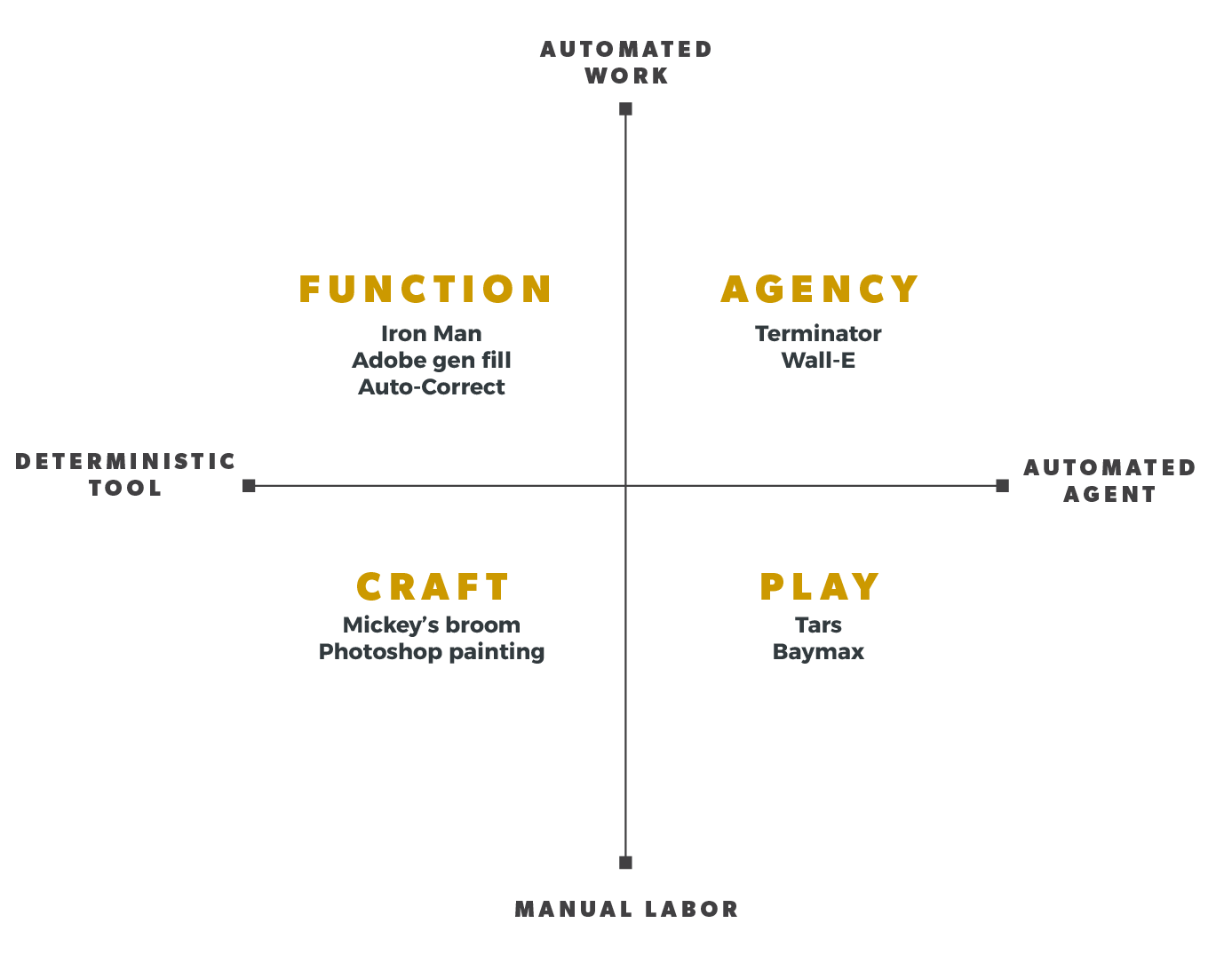
What follows are four types of uses for A.I. measured on two poles:
Agency (horizontal axis): the capacity to choose and act. On the left is the deterministic version of A.I. It is passive and requires a human to operate. To right is a more autonomous agent, independent and self-directing.
Initiating (vertical axis): the act of starting. On top, a self-directing automated agent and on the bottom, an agent dependent on human for initiating.
© Made by Matt.
Function
In the top left, we have the Functional A.I. This is the kind of A.I. that depends on human triggers to get rolling. You play the role of Tony Stark when using A.I. like this. I call this “Function” because it plays a more utilitarian role in our lives. When Microsoft added the auto-correct feature, our lives became easier. Thought it depends on man to set off a trigger, once triggered, this version of A.I. gets working all on its own for us.
2. Craft
Unlike the triggered Function quadrant, the Craft version of A.I. use depends entirely on humans for working. It’s completely passive. This is the world of something like digital painting, Mickey’s magic broom, calculators, or spreadsheet equations. It will only go as far as humans push it. It is not designed to go further than that. In the Craft category, a case could be made that this isn’t even A.I.
3. Play
While reliant upon man for its initial operating, once triggered, the Play A.I.s are totally autonomous. They call this the “generative sandbox” for it’s capacity for playing with A.I. I find many creatives live and have fun in this quadrant. It’s the space where Baymax, Tars, and R2D2 live. When the culture reacts to A.I.’s infringement upon artists (with the fair arguments against “A.I. slop”), little do we realize many are merely enjoying this category of using A.I. Some people I know play with Suno songwriting just for the simply pleasure of it.
4. Agency
Last we come to the total A.I. agent. The Terminator or Wall-E. I think these A.I. uses are the ones which strike the most fear. They are not reliant on humanity for either their work or starting their work. Once built, they are fully functioning all by themselves. This category is why you might have gotten rid of your Alexa because you thought “she” existed in the Function category but then wondered if she was listening to your conversations.
I think its fair to be both suspicion and in awe of A.I. Seth Godin likens A.I. to a talking dog. If you see a talking dog, you don’t write it off just because it can’t add 2 + 2. It’s a stinkin’ talking dog! On the other hand, we ought not depend on the talking dog as the arbiter of truth.
At the very least, we should at recognize that when we’re talking about A.I. with one another, we could be talking about totally different things.